
Calculation
middle = EMA(close, n)
upper  = middle + multiplier · ATR(atr length)
lower  = middle − multiplier · ATR(atr length)
The modern version (Linda Raschke) of Chester Keltner's channel. Same defaults as TradingView's built-in.
How to read it
- Inside the channel is the ordinary state: most closes are within two average ranges of the average.
- Closes holding above the middle line, many near the upper band, describe a steady advance.
- Band width follows the ATR: it changes slowly, without the sudden squeezes of Bollinger Bands.
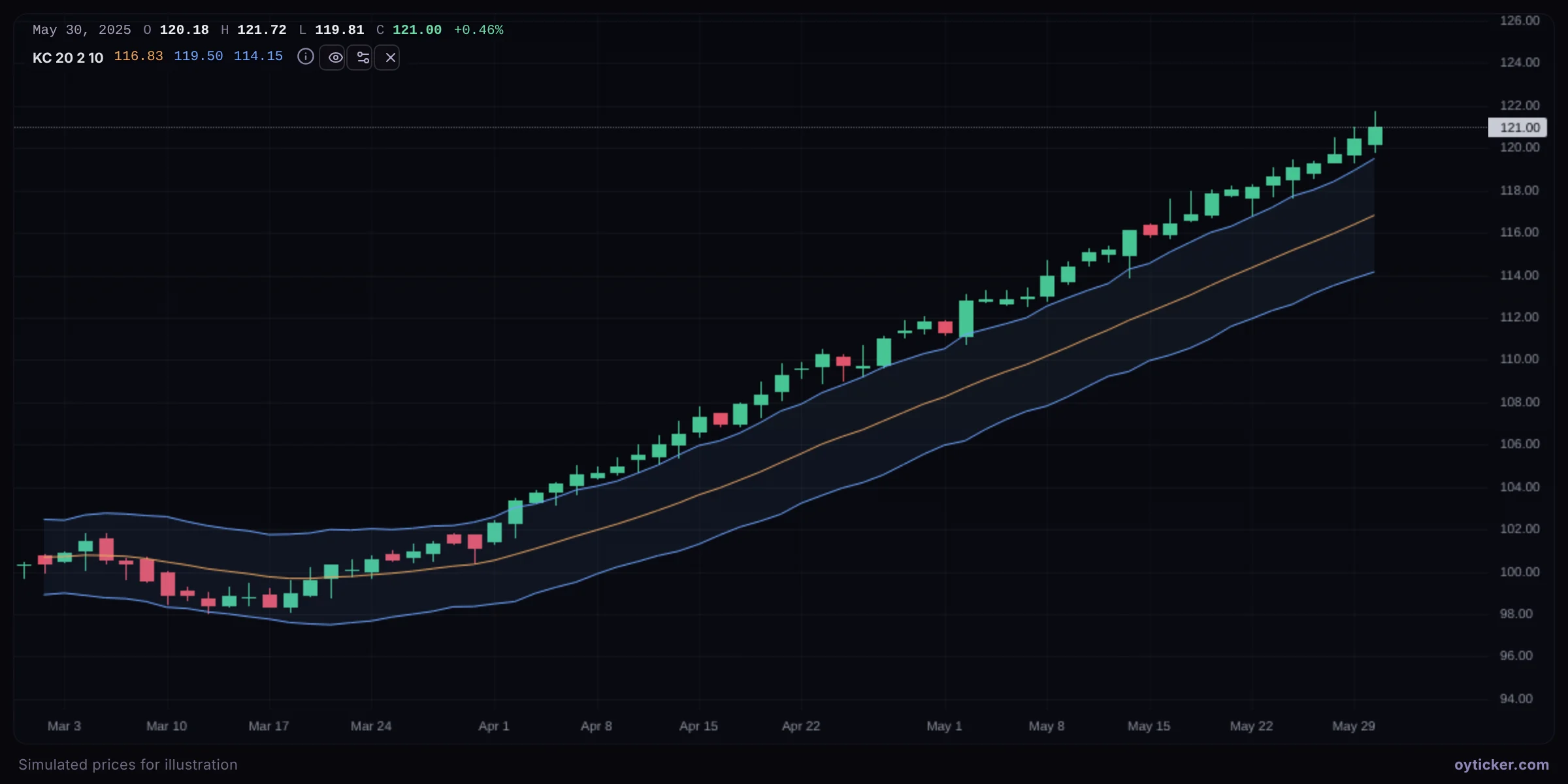
Add it in Oyticker
- Click Indicators, choose Keltner Channels.
- In its row of the legend, click the Settings button to set the length of the average, the multiplier and the ATR length.
Limits
- Built on an average and on the ATR: both lag.
- A close outside the channel is common in trends and says nothing by itself.
- The multiplier is a choice: with 1.5 or 2.5 the picture changes.
Charts in this guide use simulated prices generated for illustration; levels and outcomes shown are examples, not observations of a real market. For information only, not investment advice.