
Calculation
OBV = OBV[1] + volume     if close > close[1]
OBV = OBV[1] − volume     if close < close[1]
OBV = OBV[1]              otherwise
Introduced by Joseph Granville. The whole volume of a bar is counted on one side, however small the change of the close.
How to read it
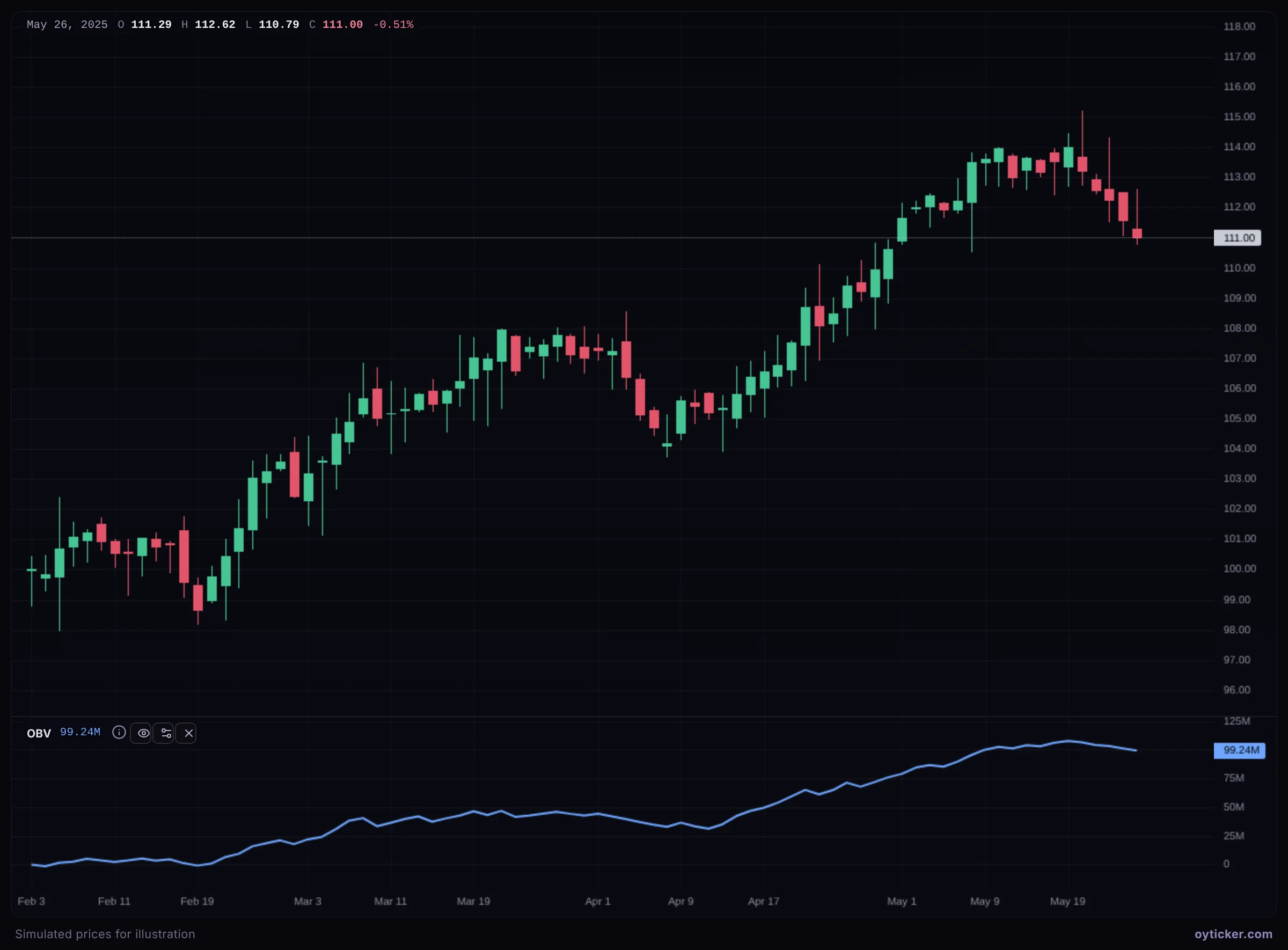
- Rising with price: volume is heavier on up closes; the advance and the volume agree.
- A price high without a new OBV high shows an advance on lighter volume than the one before.
- Its level is arbitrary: it starts at zero on the first bar of the chart.
Add it in Oyticker
- Click Indicators, choose On-balance volume.
- In its row of the legend, click the Settings button to set nothing: it has no setting.
Limits
- A bar that closes one cent higher counts its whole volume as positive.
- On a market with a partial real-time volume feed, the total follows that feed (the legend says so).
- It says nothing about who traded, only on which closes the volume fell.
Charts in this guide use simulated prices generated for illustration; levels and outcomes shown are examples, not observations of a real market. For information only, not investment advice.